SumShine
Shedding new light on numbers
Do Your Own Sums
Type numbers in the boxes and choose how to combine them.
Watch the grid light up to show you how the numbers work together.
Times Tables
Click a number to see its times table pattern on the grid.
Look at how the blocks line up - each times table makes its own special pattern.
Use "Show All" to see all the patterns at once in different colors.
Can you see similarities between some of the patterns? Why would that be?
Prime Numbers
Prime numbers are special numbers that can only be divided by 1 and themselves.
They get harder to find as numbers get bigger - after 100, they become quite rare! Even today, mathematicians are still searching for new prime numbers.
Prime numbers are used to keep secrets safe on the internet, like passwords and messages. Computer scientists use them to create unbreakable codes!
Look at the grid - can you work out why some columns never have any prime numbers in them?
Fibonacci Sequence
Leonardo Fibonacci discovered this amazing number pattern in 1202. Each number is made by adding the two numbers before it: 1, 1, 2, 3, 5, 8, 13, 21...
Nature loves this sequence! You can find it in the spiral of shells, the way tree branches grow, and how flower petals are arranged. Even galaxies in space follow this pattern.
Artists and architects use these numbers to create beautiful designs because they look natural to our eyes.
Can you work out the next number in the sequence?
Square Numbers
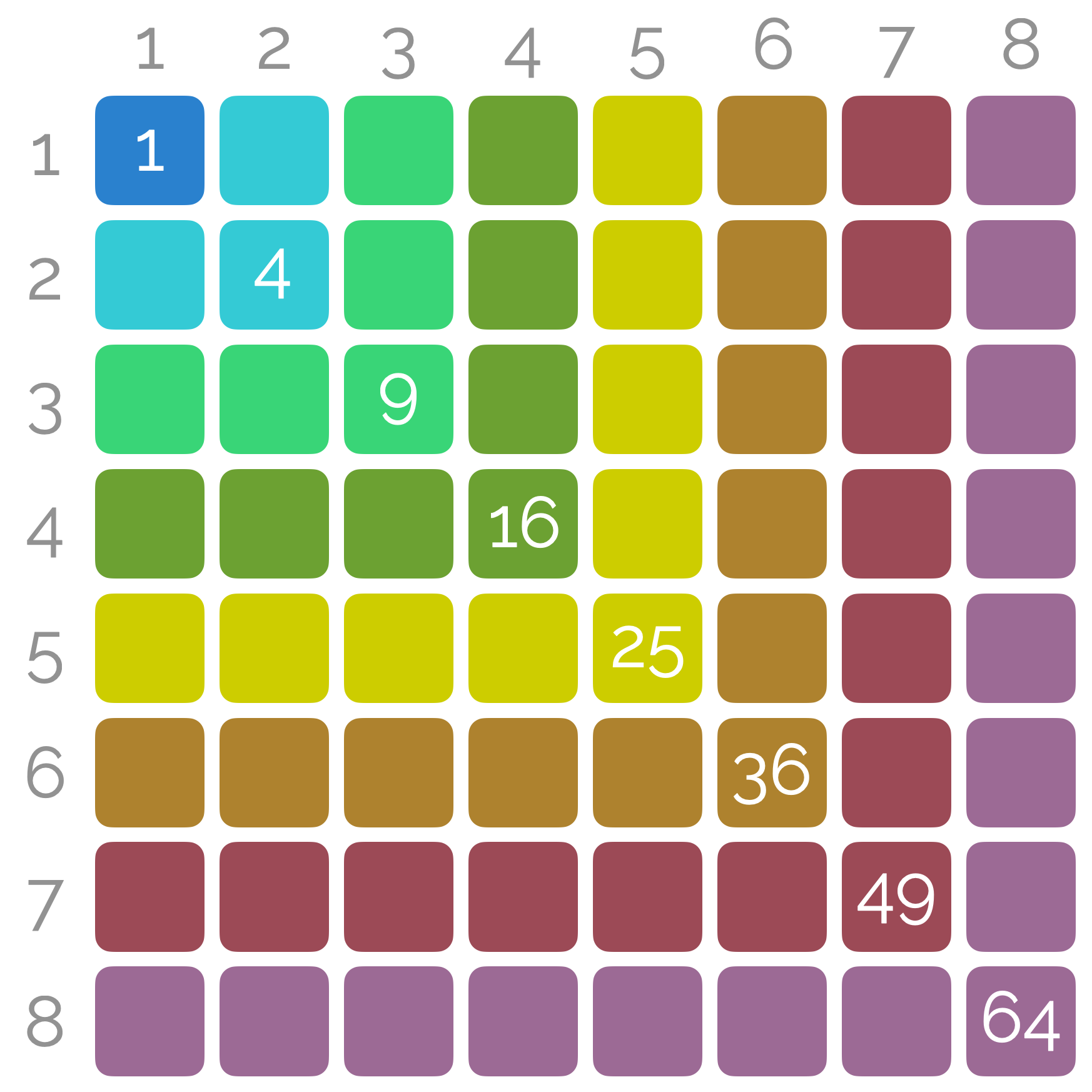
Square numbers are like magic shapes! When you multiply a number by itself, you get a square number. They're called square numbers because you can arrange that many dots or tiles into a perfect square shape.
Look at how they grow: 1, 4, 9, 16, 25, 36... Each one makes a bigger perfect square! The first square needs 1 tile, the second needs 4 tiles, the third needs 9 tiles, and they keep growing bigger and bigger.
Here's a challenge: if you count up to the next square number after 100, how many numbers do you need to skip?
Triangular Numbers
Triangular numbers show us how dots or objects stack up in a triangle shape. Each new row adds one more than the row above it, creating a perfect triangle pattern!
Watch them grow: 1, 3, 6, 10, 15, 21... The first triangle has 1 dot, the second has 3 dots, the third has 6 dots. Each time we add a new row at the bottom, our triangle gets bigger and the total number of dots is a triangular number.
If you have 52 marbles and want to arrange them in a triangle pattern, will you have any marbles left over?
Powers of 2
Powers of 2 are like a doubling magic trick! Start with 1, and each time you double it, you get the next number in the sequence. Watch what happens: 1, 2, 4, 8, 16, 32, 64... Each number is twice as big as the one before it!
These numbers are super important in computers, where everything is built on powers of 2. They're also useful when things keep splitting in two, like the branches of a tree or the cells in a growing plant.
If you keep doubling, what's the first power of 2 that's bigger than 200?
Happy Numbers
Happy numbers are like a fun number game! Take any number, square each of its digits (multiply it by itself), and add them up. Keep doing this with each new number you get. If you eventually reach 1, it's a happy number!
For example, let's try 23: First, 2² + 3² = 4 + 9 = 13. Then, 1² + 3² = 1 + 9 = 10. Finally, 1² + 0² = 1. We reached 1, so 23 is happy! Numbers that don't reach 1 are called sad numbers.
Can you figure out if 7 is a happy number? Try working it out step by step!
Lazy Caterer's Sequence
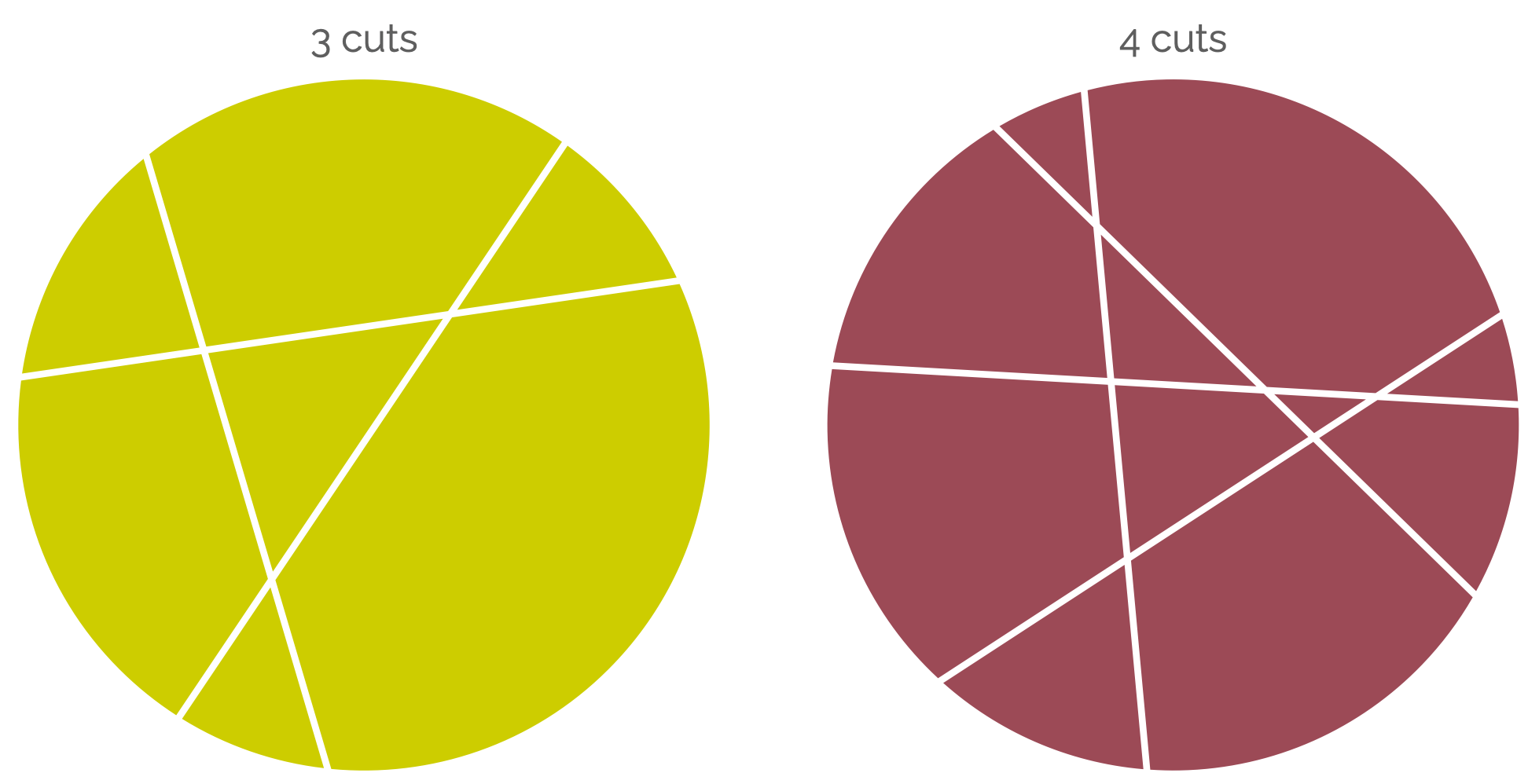
Imagine you're having a birthday party and you need to cut a round cake. With one straight cut, you can make 2 pieces. With two cuts, you can make 4 pieces. With three cuts, most people would get 6 pieces but this sequence shows that you can actually get 7 pieces!
This is called the Lazy Caterer's sequence because it shows the most pieces you can get when cutting a cake with straight lines - perfect for a lazy person who wants to do the least amount of cutting!
The sequence goes: 1, 2, 4, 7, 11, 16, 22, 29, 37, 46...
So if you have 15 friends at your party and you want everyone to get a piece of cake (including yourself), what are the fewest straight cuts you'd need to make?